
2025 Discovery Partner Fellows Announced
3 min read 30 July 2025
Three of Peter Mac’s emerging clinical researchers have been awarded 2025 Discovery Partner Fellowships.
This year, the successful Fellowship recipients are Dr Lavinia Tan, Dr Aaron K Wong, and Dr Julia Lai-Kwon.
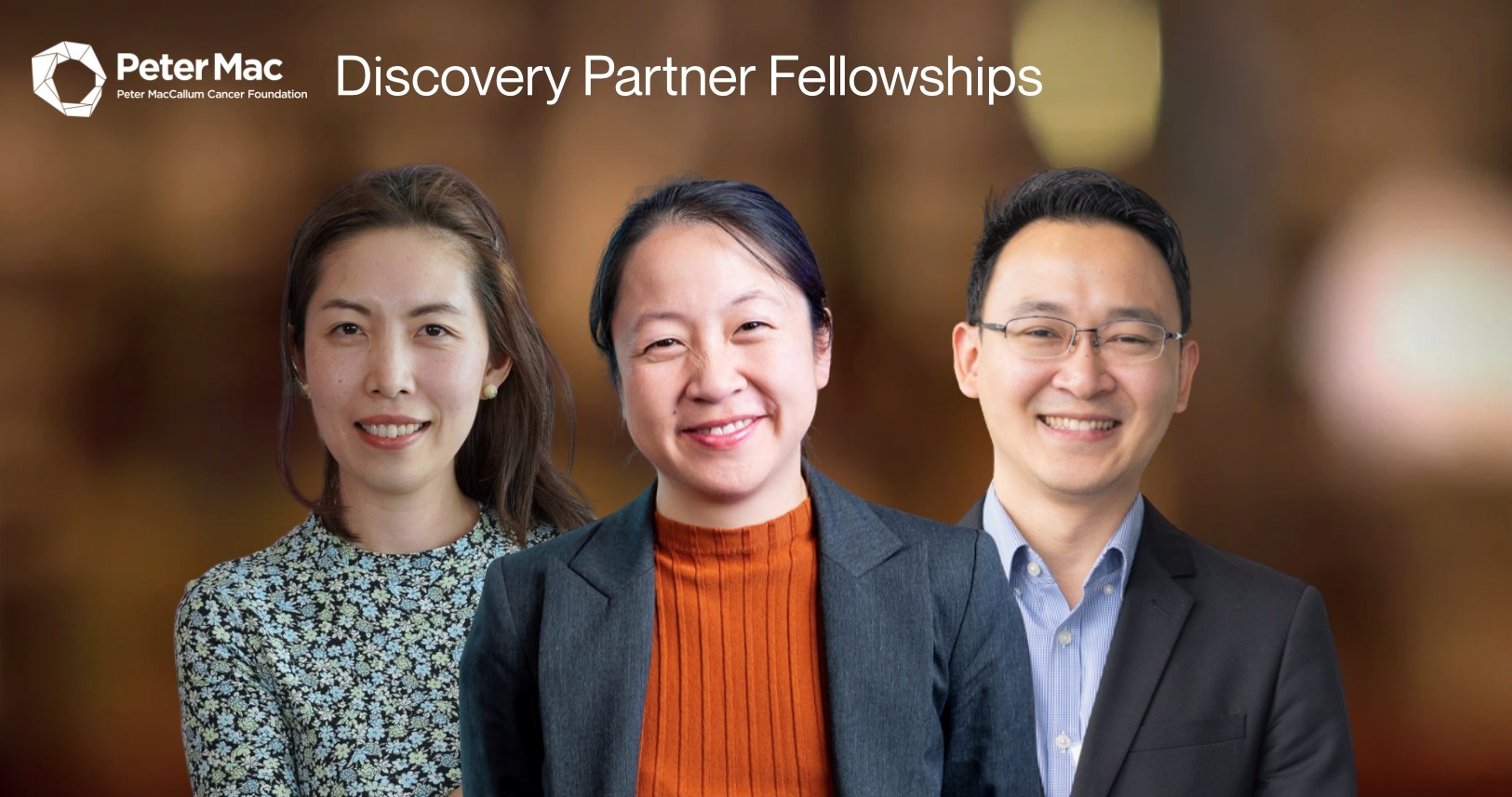 From L-R: Dr Lavinia Tan, Dr Julia Lai-Kwon and Dr Aaron K Wong
The Discovery Partner Fellowships, which are supported by the generous monthly givers to the Peter Mac Foundation, are awarded to early or mid-career Peter Mac clinicians who also perform research. The Fellowships provide clinician-researchers with financial support and the ability to carve out time from clinical roles to pursue their research projects.
By allowing clinicians with proven research track records to undertake their projects and build their research careers, the Fellowships enable lifesaving cancer research both now and into the future.
This important funding program also strengthens Peter Mac’s overall research portfolio and enhances collaboration between research and clinical care at Peter Mac.
Associate Director Clinical Research, Professor Jayesh Desai, said this fellowship program is crucial to advancing research that improves care for cancer patients.
“The Fellowship provides time away from front-line clinical roles to progress defined research projects focussed on advancing cancer treatments and improving patient outcomes and experience.
“We received an incredibly strong range of applicants this year and we look forward to the research Dr Lai-Kwon, Dr Tan and Dr Wong produce as they strive to improve outcomes for cancer patients.
“We are very proud of what this program has been able to achieve for nearly a decade since its inception and the outcomes our amazing recipients have achieved in the past,” he said.
The Peter Mac Foundation is proud to support this important program, and we thank our generous Discovery Partner donors for the role they play in enabling new cancer research discoveries. Craig Connelly, Peter Mac Foundation CEO, says:
“Each month, more than 60,000 Australians support our Discovery Partner program with extraordinary generosity. Their ongoing commitment is driving breakthrough, life-changing cancer research right here at Peter Mac.
“We congratulate our 2025 recipients and are proud to support their groundbreaking research.”
The successful Fellowship recipients and their research projects are:
Dr Lavinia Tan
Tracking and modulating the evolution of oncogene driven non-small cell lung cancer
This research project focuses on improving treatment for people with an oncogene driven lung cancer, where a genetic mutation in the tumour has been identified that causes the cancer to grow. While targeted therapies are available to treat these mutations, the cancer often becomes resistant over time. This resistance can happen not just through genetic changes, but also through other non-genetic mechanisms that are poorly understood.
Researchers at Peter Mac are collecting tissue and blood samples from lung cancer patients over time, including after treatment and, in some cases, after death. By studying these samples, the team hopes to track how cancer evolves, why some cancer cells survive treatment and eventually becomes resistant to treatment. The goal is to develop better ways to predict who will respond to therapy and to design more effective, personalised treatments in the future.
Dr Aaron K Wong
Optimising Opioid Treatment for Cancer Pain Using Precision Medicine: A National Registry Trial
This project aims to improve pain relief for people with advanced cancer, many of whom experience moderate-to-severe pain during their illness. Opioids are the main treatment for cancer pain, but they don’t work the same for everyone. Over a third of people find that certain opioids either don’t provide adequate pain relief or cause unbearable side effects. This means doctors often have to try different opioids through trial and error, which can lead to unnecessary suffering and hospital visits.
Recent research suggests that our genes, particularly neuroimmune genes, may influence how our bodies respond to opioids. Central to this work was Dr Wong’s role in establishing the feasibility of the first Australian registry of cancer patients taking opioids - the Opioid Pharmacogenomic (OPPtiC-1) Registry in collaboration with the European Opioid Pharmacogenetic Study (EPOS) group – that longitudinally collects paired blood samples and clinical data to better understand these individual differences. His discovery work has contributed new understanding on how neuroimmune gene pathways may influence a patient’s response to opioid treatments. Building on strong international collaborations and clinical trial networks, this project will now expand to a national registry trial (GENOS), focusing on offering “the right opioid, for the right person, at the right time”.
Dr Julia Lai-Kwon
From PROmise to PROgress: implementing Epic-integrated electronic patient reported outcome symptom monitoring into routine care
This project aims to improve cancer care by helping patients and their caregivers share how they’re feeling with their healthcare team using simple digital tools known as electronic patient-reported outcomes (ePROs). The program allows patients to report their symptoms or side-effects from home using an app on their phone or a computer. This way, the healthcare team can quickly see if someone needs help between hospital visits. This information is also immediately available within their electronic medical record. While these programs are widely used overseas, they are not yet routine in Australia.
This project will address this gap by introducing ePROs to Peter Mac over the next 5 years across a range of different cancers. We will also create easy-to understand guides so patients, caregivers and the healthcare team can learn how to use these new tools. By listening more closely to what patients have to say about their own health, this program hopes to make cancer care safer, more personalised and more efficient.
@Follow us on Instagram (@SupportPeterMac)